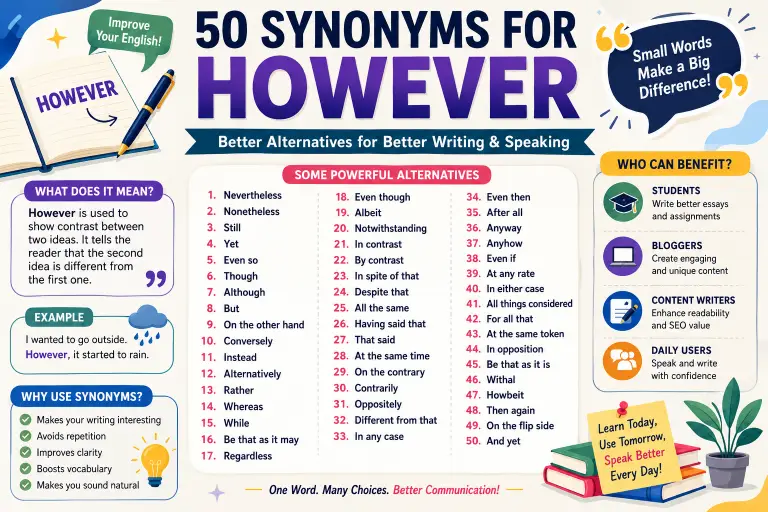
Have you ever used the word however again and again while writing? It can make your writing sound repetitive. Learning different synonyms for however helps you express your ideas in a fresh and natural way.
For example, you may write, “I wanted to go outside. However, it started to rain.” You can replace however with another word that fits the sentence. This makes your writing more interesting.
The word however is used to show a contrast between two ideas. It tells readers that the second idea is different from the first one. Knowing synonyms for however is helpful for students, bloggers, content writers, and anyone who wants to write or speak better English.
Learn more: Synonyms for Sad: Better Words to Express Your Feelings
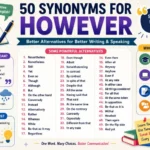
50 Synonyms for However
1. Nevertheless (Adverb)
Pronunciation: /ˌnev.ə.ðəˈles/
Meaning:
This word shows that something is true even after a problem or difficulty.
Examples:
- It was raining. Nevertheless, we played football.
- She was tired. Nevertheless, she finished her homework.
2. Nonetheless (Adverb)
Pronunciation: /ˌnʌn.ðəˈles/
Meaning:
It means “even so” or “despite that.”
Examples:
- The test was hard. Nonetheless, I passed.
- He forgot the map. Nonetheless, he found the place.
3. Still (Adverb)
Pronunciation: /stɪl/
Meaning:
It shows that something continues or happens despite another fact.
Examples:
- It was cold. Still, we went for a walk.
- She made a mistake. Still, everyone clapped.
4. Yet (Conjunction/Adverb)
Pronunciation: /jet/
Meaning:
It joins two opposite ideas in one sentence.
Examples:
- He is young, yet very wise.
- The food was cheap, yet delicious.
5. Even So (Phrase)
Pronunciation: /ˈiː.vən səʊ/
Meaning:
It means that something is true despite another fact.
Examples:
- I felt sleepy. Even so, I kept reading.
- The shop was busy. Even so, we got help quickly.
6. Though (Conjunction/Adverb)
Pronunciation: /ðəʊ/
Meaning:
It shows contrast between two ideas.
Examples:
- I liked the movie. Though, it was too long.
- She smiled. Though, she looked nervous.
7. Although (Conjunction)
Pronunciation: /ɔːlˈðəʊ/
Meaning:
It introduces an idea that contrasts with another.
Examples:
- Although it rained, we enjoyed the picnic.
- Although he was busy, he called me.
8. Though Even (Phrase)
Pronunciation: /ðəʊ ˈiː.vən/
Meaning:
It adds a stronger contrast in some writing styles.
Examples:
- Though even the weather changed, they stayed happy.
- Though even experts agreed, she checked again.
9. But (Conjunction)
Pronunciation: /bʌt/
Meaning:
It connects two opposite ideas.
Examples:
- I wanted tea, but I drank coffee.
- She ran fast, but missed the bus.
10. On the Other Hand (Phrase)
Pronunciation: /ɒn ði ˈʌð.ə hænd/
Meaning:
It introduces another side of an idea.
Examples:
- This phone is cheap. On the other hand, it is slow.
- The job pays well. On the other hand, it is stressful.
Quick Tip:
When however starts a sentence, place a comma after it. When it joins two independent clauses, use a semicolon before however and a comma after it.
11. Conversely (Adverb)
Pronunciation: /ˈkɒn.vɜː.sli/
Meaning:
It shows the opposite situation.
Examples:
- Some people love winter. Conversely, others prefer summer.
- Cats enjoy quiet places. Conversely, dogs like busy parks.
12. Instead (Adverb)
Pronunciation: /ɪnˈsted/
Meaning:
It means one thing happens in place of another.
Examples:
- We stayed home instead of traveling.
- He drank juice instead of soda.
13. Alternatively (Adverb)
Pronunciation: /ɔːlˈtɜː.nə.tɪv.li/
Meaning:
It offers another choice or idea.
Examples:
- You can drive. Alternatively, take the train.
- We can meet today. Alternatively, let’s meet tomorrow.
14. Rather (Adverb)
Pronunciation: /ˈrɑː.ðər/
Meaning:
It shows preference or a different choice.
Examples:
- I would rather stay home tonight.
- She chose tea rather than coffee.
15. Whereas (Conjunction)
Pronunciation: /weərˈæz/
Meaning:
It compares two different ideas.
Examples:
- My brother likes football, whereas I enjoy cricket.
- She wakes up early, whereas I sleep late.
16. While (Conjunction)
Pronunciation: /waɪl/
Meaning:
It can show contrast between two ideas.
Examples:
- While I like pizza, my sister prefers pasta.
- While the room is small, it feels cozy.
17. Be That as It May (Phrase)
Pronunciation: /biː ðæt əz ɪt meɪ/
Meaning:
It means “even if that is true.”
Examples:
- Be that as it may, we must finish the project.
- Be that as it may, the rules still apply.
18. Regardless (Adverb)
Pronunciation: /rɪˈɡɑːrd.ləs/
Meaning:
It means something happens without being affected by another fact.
Examples:
- We went hiking regardless of the weather.
- She smiled regardless of the bad news.
19. Even Though (Conjunction)
Pronunciation: /ˈiː.vən ðəʊ/
Meaning:
It shows that two ideas are different or opposite.
Examples:
- Even though it was late, we kept talking.
- He smiled even though he was nervous.
20. Albeit (Conjunction)
Pronunciation: /ɔːlˈbiː.ɪt/
Meaning:
It means “although” and adds a small contrast.
Examples:
- The trip was fun, albeit a little tiring.
- She gave a short, albeit helpful, answer.
21. Notwithstanding (Preposition/Adverb/Conjunction)
Pronunciation: /ˌnɒt.wɪθˈstæn.dɪŋ/
Meaning:
It means “despite that.”
Examples:
- Notwithstanding the rain, the match continued.
- He joined us notwithstanding his busy schedule.
22. In Contrast (Phrase)
Pronunciation: /ɪn ˈkɒn.trɑːst/
Meaning:
It shows a clear difference between two ideas.
Examples:
- My room is quiet. In contrast, the living room is noisy.
- This bag is light. In contrast, that one is heavy.
23. By Contrast (Phrase)
Pronunciation: /baɪ ˈkɒn.trɑːst/
Meaning:
It introduces an opposite idea.
Examples:
- Tom is calm. By contrast, Jake is very energetic.
- Summer is hot. By contrast, winter is cold.
24. In Spite of That (Phrase)
Pronunciation: /ɪn spaɪt əv ðæt/
Meaning:
It means something happens despite another fact.
Examples:
- The road was busy. In spite of that, we arrived early.
- She was ill. In spite of that, she attended class.
25. Despite That (Phrase)
Pronunciation: /dɪˈspaɪt ðæt/
Meaning:
It shows that something happens even after a problem.
Examples:
- He forgot his notes. Despite that, he spoke well.
- The meal was expensive. Despite that, it was worth it.
26. All the Same (Phrase)
Pronunciation: /ɔːl ðə seɪm/
Meaning:
It means “even so.”
Examples:
- I was tired. All the same, I finished my work.
- The game was difficult. All the same, we enjoyed it.
27. Having Said That (Phrase)
Pronunciation: /ˈhæv.ɪŋ sed ðæt/
Meaning:
It introduces a different opinion after one statement.
Examples:
- The book is long. Having said that, it is interesting.
- The phone is costly. Having said that, it works well.
28. That Said (Phrase)
Pronunciation: /ðæt sed/
Meaning:
It adds a different point after a statement.
Examples:
- The task is simple. That said, it takes time.
- The weather is nice. That said, bring a jacket.
29. At the Same Time (Phrase)
Pronunciation: /æt ðə seɪm taɪm/
Meaning:
It shows two ideas happening together, often with contrast.
Examples:
- She is kind. At the same time, she is very honest.
- The movie was funny. At the same time, it was emotional.
30. On the Contrary (Phrase)
Pronunciation: /ɒn ðə ˈkɒn.trə.ri/
Meaning:
It means the opposite is true.
Examples:
- I don’t dislike it. On the contrary, I love it.
- He wasn’t upset. On the contrary, he looked happy.
31. Contrarily (Adverb)
Pronunciation: /kənˈtreə.rə.li/
Meaning:
It means in an opposite way.
Examples:
- Most birds flew south. Contrarily, a few stayed.
- Many people agreed. Contrarily, she disagreed.
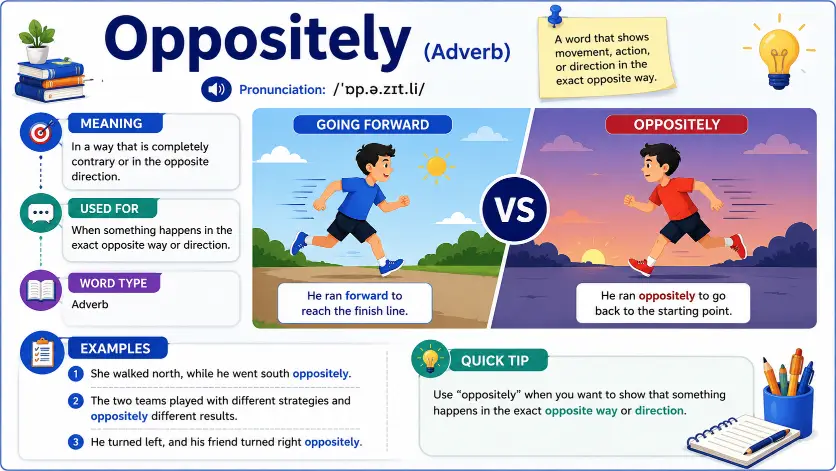
32. Oppositely (Adverb)
Pronunciation: /ˈɒp.ə.zɪt.li/
Meaning:
It means in the opposite manner.
Examples:
- We think oppositely about this topic.
- The twins dressed oppositely today.
33. Different from That (Phrase)
Pronunciation: /ˈdɪf.ər.ənt frəm ðæt/
Meaning:
It introduces another or opposite idea.
Examples:
- Different from that, my opinion has changed.
- Different from that, the second plan is easier.
34. In Any Case (Phrase)
Pronunciation: /ɪn ˈen.i keɪs/
Meaning:
It means something is true no matter what.
Examples:
- We may leave early. In any case, be ready.
- The meeting might change. In any case, check your email.
35. Even Then (Phrase)
Pronunciation: /ˈiː.vən ðen/
Meaning:
It means something is still true after another event.
Examples:
- We left early. Even then, we reached late.
- He practiced every day. Even then, he felt nervous.
36. After All (Phrase)
Pronunciation: /ˈɑːf.tər ɔːl/
Meaning:
It adds a reason or shows a different point.
Examples:
- She helped me. After all, we are friends.
- Don’t worry. After all, everyone makes mistakes.
37. Anyway (Adverb)
Pronunciation: /ˈen.i.weɪ/
Meaning:
It changes the focus or returns to the main point.
Examples:
- It was raining. Anyway, we enjoyed the trip.
- I was tired. Anyway, I finished my work.
38. Anyhow (Adverb)
Pronunciation: /ˈen.i.haʊ/
Meaning:
It means “in any case” or “despite that.”
Examples:
- We missed the bus. Anyhow, we reached on time.
- The plan changed. Anyhow, everything worked out.
39. Even If (Conjunction)
Pronunciation: /ˈiː.vən ɪf/
Meaning:
It shows that something will happen no matter what.
Examples:
- I will help you even if I am busy.
- She smiles even if she feels sad.
40. At Any Rate (Phrase)
Pronunciation: /æt ˈen.i reɪt/
Meaning:
It means “whatever happens.”
Examples:
- We should leave now. At any rate, don’t be late.
- The shop may close. At any rate, let’s go.
41. In Either Case (Phrase)
Pronunciation: /ɪn ˈaɪ.ðər keɪs/
Meaning:
It means the result is the same in both situations.
Examples:
- We can drive or walk. In either case, we will arrive.
- You can call or text. In either case, let me know.
42. All Things Considered (Phrase)
Pronunciation: /ɔːl θɪŋz kənˈsɪd.ərd/
Meaning:
It means after thinking about everything.
Examples:
- All things considered, it was a good day.
- All things considered, we made the right choice.
43. For All That (Phrase)
Pronunciation: /fɔːr ɔːl ðæt/
Meaning:
It means “despite everything.”
Examples:
- He was upset. For all that, he stayed polite.
- The road was long. For all that, we enjoyed the drive.
44. At the Same Token (Phrase)
Pronunciation: /æt ðə seɪm ˈtəʊ.kən/
Meaning:
It introduces another related or opposite idea.
Examples:
- She is careful. At the same token, she is confident.
- The book is short. At the same token, it is informative.
45. In Opposition (Phrase)
Pronunciation: /ɪn ˌɒp.əˈzɪʃ.ən/
Meaning:
It shows a clear opposite idea.
Examples:
- His view was in opposition to mine.
- Their plan stood in opposition to ours.
46. Be That as It Is (Phrase)
Pronunciation: /biː ðæt əz ɪt ɪz/
Meaning:
It means accepting a fact while moving to another point.
Examples:
- Be that as it is, we must continue.
- Be that as it is, the decision is final.
47. Withal (Adverb)
Pronunciation: /wɪˈðɔːl/
Meaning:
It means “despite that.” It is an old-fashioned word.
Examples:
- The task was hard. Withal, we completed it.
- She was quiet. Withal, everyone respected her.
48. Howbeit (Adverb/Conjunction)
Pronunciation: /haʊˈbiː.ɪt/
Meaning:
It means “however,” but it is rarely used today.
Examples:
- The idea was good. Howbeit, it needed changes.
- He accepted the offer. Howbeit, he asked for more time.
49. Then Again (Phrase)
Pronunciation: /ðen əˈɡen/
Meaning:
It introduces another way of thinking.
Examples:
- I may stay home. Then again, I might go out.
- The movie looks fun. Then again, I have work to do.
50. On the Flip Side (Phrase)
Pronunciation: /ɒn ðə flɪp saɪd/
Meaning:
It introduces the opposite side of an idea.
Examples:
- This laptop is fast. On the flip side, it costs more.
- The house is beautiful. On the flip side, it is far from town.
Formal vs Informal Synonyms for However
| Formal Synonyms | Informal Synonyms |
|---|---|
| Nevertheless | But |
| Nonetheless | Still |
| Conversely | Yet |
| Notwithstanding | Though |
| On the Contrary | Even So |
| In Contrast | On the Other Hand |
| Having Said That | Anyway |
Conclusion
Learning different synonyms for however can make your writing and speaking clearer, smoother, and more interesting. Using the right word helps you avoid repetition and express your ideas with confidence. Practice these synonyms in your emails, essays, blog posts, school work, and daily conversations. The more you use them, the more natural and fluent your English will become.

Hi, I’m Sophia Bennett, an English language educator and writer dedicated to helping readers expand their vocabulary and improve their writing. Through educational articles on synonyms, antonyms, grammar, and word usage, I aim to make learning English enjoyable, engaging, and useful for everyday life.