Have you ever worked hard but still did not get the result you wanted? It can happen to anyone. A student may fail an exam. A business may lose money. A team may not win a match. In situations like this, knowing various synonyms for failure can clarify your ideas.
The word failure means not reaching a goal or not succeeding at something. It can describe a person, a plan, an event, or a task that did not work as expected.
Learning synonyms for failure helps everyone. Students gain new words. Bloggers and content writers improve their skills. English learners also build better vocabulary. It also makes your writing and speaking more natural, interesting, and professional.
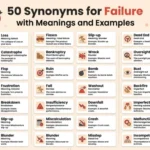
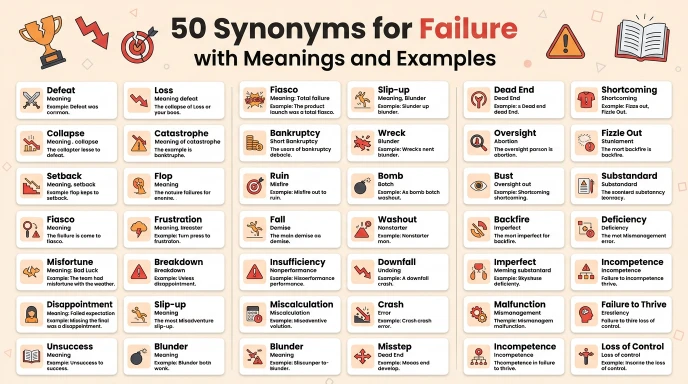
50 Synonyms for Failure
1. Defeat (de-feat)
Pronunciation: /dɪˈfiːt/
Meaning:
It means losing a game, battle, or competition.
Examples:
- Our team faced defeat in the final match.
- She accepted the defeat with a smile.
2. Loss (loss)
Pronunciation: /lɒs/
Meaning:
It means not winning or losing something valuable.
Examples:
- The company reported a financial loss.
- His loss in the race made him stronger.
3. Setback (set-back)
Pronunciation: /ˈset.bæk/
Meaning:
It means a problem that slows your progress.
Examples:
- The heavy rain caused a setback.
- One setback cannot stop your dreams.
4. Collapse (col-lapse)
Pronunciation: /kəˈlæps/
Meaning:
It means something suddenly stops working or falls apart.
Examples:
- The old building ended in collapse.
- The business suffered a sudden collapse.
5. Breakdown (break-down)
Pronunciation: /ˈbreɪk.daʊn/
Meaning:
It means something stops working properly.
Examples:
- Our car had a breakdown yesterday.
- Poor planning caused the project’s breakdown.
6. Disaster (dis-as-ter)
Pronunciation: /dɪˈzɑː.stər/
Meaning:
It means something goes very badly.
Examples:
- The event became a disaster.
- Dinner turned into a disaster after it burned.
7. Flop (flop)
Pronunciation: /flɒp/
Meaning:
It means something that fails to succeed.
Examples:
- The new movie was a flop.
- His first business idea was a flop.
8. Fiasco (fi-as-co)
Pronunciation: /fiˈæs.kəʊ/
Meaning:
It means a complete and embarrassing failure.
Examples:
- The meeting became a fiasco.
- Their plan ended in a fiasco.
9. Misfortune (mis-for-tune)
Pronunciation: /mɪsˈfɔː.tʃuːn/
Meaning:
It means bad luck or an unhappy event.
Examples:
- The family faced great misfortune.
- His misfortune taught him patience.
10. Frustration (frus-tra-tion)
Pronunciation: /frʌˈstreɪ.ʃən/
Meaning:
It means feeling upset because something did not work.
Examples:
- She felt frustration after the interview.
- The long wait caused frustration.
11. Shortcoming (short-com-ing)
Pronunciation: /ˈʃɔːrtˌkʌm.ɪŋ/
Meaning:
It means a weakness or something that is missing.
Examples:
- Every plan has a shortcoming.
- He worked hard to improve his shortcomings.
12. Mishap (mis-hap)
Pronunciation: /ˈmɪs.hæp/
Meaning:
It means a small accident or mistake.
Examples:
- A small mishap delayed our journey.
- The picnic had one funny mishap.
13. Error (er-ror)
Pronunciation: /ˈer.ər/
Meaning:
It means doing something the wrong way.
Examples:
- I found an error in the report.
- One error changed the final score.
14. Mistake (mis-take)
Pronunciation: /mɪˈsteɪk/
Meaning:
It means doing something incorrectly.
Examples:
- Everyone makes a mistake sometimes.
- She quickly corrected her mistake.
15. Blunder (blun-der)
Pronunciation: /ˈblʌn.dər/
Meaning:
It means a big and careless mistake.
Examples:
- The player made a costly blunder.
- His blunder surprised the whole team.
16. Miss (miss)
Pronunciation: /mɪs/
Meaning:
It means not reaching the goal or target.
Examples:
- His shot was a miss.
- We had one miss before we finally succeeded.
17. Letdown (let-down)
Pronunciation: /ˈlet.daʊn/
Meaning:
It means something that causes disappointment.
Examples:
- The ending of the movie was a letdown.
- Missing the concert was a big letdown.
18. Disappointment (dis-ap-point-ment)
Pronunciation: /ˌdɪs.əˈpɔɪnt.mənt/
Meaning:
It means feeling sad because something did not happen as hoped.
Examples:
- The canceled trip was a disappointment.
- He turned his disappointment into motivation.
19. Deficiency (de-fi-cien-cy)
Pronunciation: /dɪˈfɪʃ.ən.si/
Meaning:
It means a lack of something that is needed.
Examples:
- The report showed a deficiency in planning.
- Practice helped fix the deficiency.
20. Weakness (weak-ness)
Pronunciation: /ˈwiːk.nəs/
Meaning:
It means a part that is not strong.
Examples:
- Speaking in public was her weakness.
- Everyone has at least one weakness.
21. Fault (fault)
Pronunciation: /fɔːlt/
Meaning:
It means a mistake or problem.
Examples:
- It was my fault we missed the bus.
- The engineer repaired the fault quickly.
22. Defect (de-fect)
Pronunciation: /ˈdiː.fekt/
Meaning:
It means a flaw that keeps something from working well.
Examples:
- The toy had a small defect.
- They returned the phone because of a defect.
23. Flaw (flaw)
Pronunciation: /flɔː/
Meaning:
It means a small weakness or problem.
Examples:
- The plan had one small flaw.
- She found a flaw in the design.
24. Limitation (lim-i-ta-tion)
Pronunciation: /ˌlɪm.ɪˈteɪ.ʃən/
Meaning:
It means something that stops or limits progress.
Examples:
- Money was our biggest limitation.
- Every machine has a limitation.
25. Debacle (de-ba-cle)
Pronunciation: /deɪˈbɑː.kəl/
Meaning:
It means a complete and embarrassing failure.
Examples:
- The launch became a debacle.
- Everyone remembered the debate debacle.
26. Washout (wash-out)
Pronunciation: /ˈwɒʃ.aʊt/
Meaning:
It means something that completely fails.
Examples:
- The concert was a washout because of rain.
- His first performance was a washout.
27. Reversal (re-ver-sal)
Pronunciation: /rɪˈvɜːr.səl/
Meaning:
It means an unexpected change from success to failure.
Examples:
- The company faced a sudden reversal.
- One reversal did not end their journey.
28. Dead End (dead-end)
Pronunciation: /ˌded ˈend/
Meaning:
It means a situation with no progress.
Examples:
- Our discussion reached a dead end.
- The old plan became a dead end.
29. Dud (dud)
Pronunciation: /dʌd/
Meaning:
It means something that does not work or succeed.
Examples:
- The new product was a dud.
- His first invention turned out to be a dud.
30. Misfire (mis-fire)
Pronunciation: /ˌmɪsˈfaɪər/
Meaning:
It means something that does not work as planned.
Examples:
- The advertising campaign was a misfire.
- His joke was a complete misfire.
31. Slip (slip)
Pronunciation: /slɪp/
Meaning:
It means a small mistake.
Examples:
- One slip changed the game.
- Don’t worry about a small slip.
32. Missed Opportunity (missed op-por-tu-ni-ty)
Pronunciation: /ˌmɪst ˌɒp.ərˈtjuː.nə.ti/
Meaning:
It means a chance that was not used.
Examples:
- Skipping the interview was a missed opportunity.
- That decision became a missed opportunity.
33. Underachievement (un-der-a-chieve-ment)
Pronunciation: /ˌʌn.dər.əˈtʃiːv.mənt/
Meaning:
It means performing below your ability.
Examples:
- The teacher noticed his underachievement.
- Hard work can overcome underachievement.
34. Downfall (down-fall)
Pronunciation: /ˈdaʊn.fɔːl/
Meaning:
It means a sudden fall from success.
Examples:
- Pride became his downfall.
- The company’s downfall shocked everyone.
35. Ruin (ru-in)
Pronunciation: /ˈruː.ɪn/
Meaning:
It means complete damage or failure.
Examples:
- Bad choices led to ruin.
- The fire brought ruin to the old house.
36. Bankruptcy (bank-rupt-cy)
Pronunciation: /ˈbæŋk.rʌpt.si/
Meaning:
It means having no money to pay debts.
Examples:
- The business filed for bankruptcy.
- Poor planning ended in bankruptcy.
37. Undoing (un-do-ing)
Pronunciation: /ʌnˈduː.ɪŋ/
Meaning:
It means the cause of someone’s failure.
Examples:
- His anger became his undoing.
- Careless spending was the company’s undoing.
38. Collapse (col-lapse)
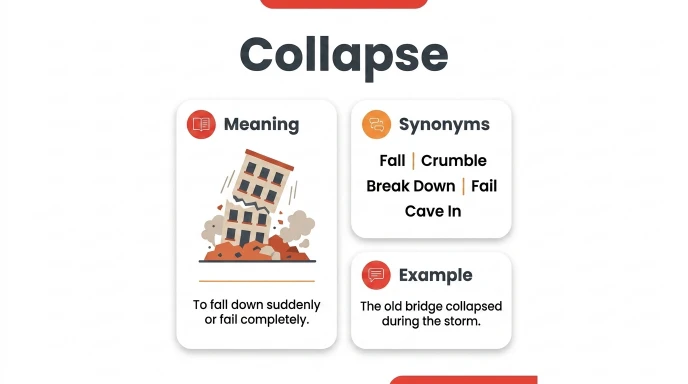
Pronunciation: /kəˈlæps/
Meaning:
It means a complete failure or sudden end.
Examples:
- The bridge collapsed after the storm.
- The agreement ended in complete collapse.
39. Breakdown (break-down)
Pronunciation: /ˈbreɪk.daʊn/
Meaning:
It means something stops working or fails.
Examples:
- The machine had another breakdown.
- Poor teamwork caused the breakdown.
40. Frustrated Attempt (frus-trat-ed at-tempt)
Pronunciation: /frʌˈstreɪ.tɪd əˈtempt/
Meaning:
It means trying hard but not succeeding.
Examples:
- It was a frustrated attempt to fix the bike.
- Her frustrated attempt taught her patience.
41. Unsuccessful Effort (un-suc-cess-ful ef-fort)
Pronunciation: /ˌʌn.səkˈses.fəl ˈef.ərt/
Meaning:
It means an effort that does not succeed.
Examples:
- Their unsuccessful effort was still appreciated.
- Every unsuccessful effort teaches a lesson.
42. Stumble (stum-ble)
Pronunciation: /ˈstʌm.bəl/
Meaning:
It means a small failure or mistake.
Examples:
- One stumble did not stop her journey.
- His first stumble made him stronger.
43. False Start (false start)
Pronunciation: /ˌfɔːls ˈstɑːrt/
Meaning:
It means beginning something the wrong way.
Examples:
- We had a false start but finished well.
- The race restarted after a false start.
44. Nonperformance (non-per-form-ance)
Pronunciation: /ˌnɒn.pəˈfɔː.məns/
Meaning:
It means not doing the required work.
Examples:
- The team was warned about nonperformance.
- Nonperformance affected the final result.
45. Ineffectiveness (in-ef-fec-tive-ness)
Pronunciation: /ˌɪn.ɪˈfek.tɪv.nəs/
Meaning:
It means not working as expected.
Examples:
- The medicine showed ineffectiveness.
- We changed the plan because of its ineffectiveness.
46. Failure to Deliver (fail-ure to de-liv-er)
Pronunciation: /ˈfeɪl.jər tə dɪˈlɪv.ər/
Meaning:
It means not doing what was promised.
Examples:
- The company’s failure to deliver upset customers.
- His failure to deliver caused delays.
47. Discomfiture (dis-com-fi-ture)
Pronunciation: /dɪsˈkʌm.fɪ.tʃər/
Meaning:
It means embarrassment caused by failure.
Examples:
- His mistake caused great discomfiture.
- She hid her discomfiture with a smile.
48. Defeatism (de-feat-ism)
Pronunciation: /dɪˈfiː.tɪ.zəm/
Meaning:
It means believing you cannot succeed.
Examples:
- Defeatism will not solve the problem.
- The coach told the team to avoid defeatism.
49. Missed Target (missed tar-get)
Pronunciation: /ˌmɪst ˈtɑːr.ɡɪt/
Meaning:
It means not reaching the planned goal.
Examples:
- The sales team missed the target this month.
- One missed target will not define your future.
50. Unsuccessful Outcome (un-suc-cess-ful out-come)
Pronunciation: /ˌʌn.səkˈses.fəl ˈaʊt.kʌm/
Meaning:
It means the final result was not successful.
Examples:
- The experiment had an unsuccessful outcome.
- We discussed the unsuccessful outcome calmly.
Conclusion
Knowing different words for failure is useful. It helps you choose the right one for each situation. It boosts your writing, blogging, and speaking. It also helps with everyday talk. Your vocabulary becomes richer and more natural. Practice these words in emails, essays, school assignments, blog posts, and daily conversations. The more you use them, the more confident and fluent your English will become.
Read more about!

Hi, I’m Sophia Bennett, an English language educator and writer dedicated to helping readers expand their vocabulary and improve their writing. Through educational articles on synonyms, antonyms, grammar, and word usage, I aim to make learning English enjoyable, engaging, and useful for everyday life.